Cross country skiing history and information, olympic athletes, olympic games and more. Everything you could want to know about cross country skiing in the Olympics.
The cross-country
skiing events at the 2006 Winter
Olympics featured 12 medal winning events, from February
11, 2006 to 26
February 2006 at
Pragelato
in Turin.
Contents |
Medal table
| Rank | Nation | Gold | Silver | Bronze | Total |
|---|---|---|---|---|---|
| 1 |  Sweden (SWE) Sweden (SWE) |
3 | 0 | 2 | 5 |
| 2 |  Estonia (EST) Estonia (EST) |
3 | 0 | 0 | 3 |
| 3 |  Russia (RUS) Russia (RUS) |
2 | 2 | 3 | 7 |
| 4 |  Italy (ITA) Italy (ITA) |
2 | 0 | 2 | 4 |
| 5 |  Czech
Republic (CZE) Czech
Republic (CZE) |
1 | 2 | 0 | 3 |
| 6 |  Canada (CAN) Canada (CAN) |
1 | 1 | 0 | 2 |
| 7 |  Germany (GER) Germany (GER) |
0 | 3 | 1 | 4 |
 Norway (NOR) Norway (NOR) |
0 | 3 | 1 | 4 | |
| 9 |  France (FRA) France (FRA) |
0 | 1 | 0 | 1 |
| 10 |  Austria (AUT) Austria (AUT) |
0 | 0 | 1 | 1 |
 Finland (FIN) Finland (FIN) |
0 | 0 | 1 | 1 | |
 Poland (POL) Poland (POL) |
0 | 0 | 1 | 1 |
Men's events
The 15 km + 15 double pursuit was the first of the men's events, and was held on 12 February 2006, after the women's. The event began with a 15 km mass start in the classical style; the skiers then changed skis while the clock was still running, and proceed to complete the 15 km course once again, this time in free style. The pursuit in this format had been skied three times at the Nordic skiing World Championships, and the Frenchman Vincent Vittoz was the reigning World Champion. A pursuit event similar to this was skied at the 2002 Winter Olympics, where the gold was shared between Thomas Alsgaard (now retired) and Frode Estil, but the distance was 20 km, not 30.
The event opened dramatically as Estil fell at the start, causing a mass collision. Then the pack kept together almost until the end, with skiers continually trailing off as they could not keep up with the pace. Eventually, five men came in to the finishing straight together, after Anders Södergren of Sweden had tried to pull away on the final lap. However, Södergren could not keep up with the pace, and Russian Eugeni Dementiev pulled away to defeat the defending Olympic champion Estil and win Russia's first gold medal of the Games.
| Medal | Athlete | Time |
|---|---|---|
| Gold | Yevgeny
Dementyev (RUS) |
1:17:00.8 |
| Silver | Frode Estil (NOR) |
1:17:01.4 |
| Bronze | Pietro Piller
Cottrer (ITA) |
1:17:01.7 |
Team sprint, classical style
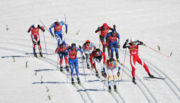
This competition took place on 14 February, beginning at 10:40 local time. There were two athletes on each team, and each NOC is entitled to one participating team. The athletes took turns at going through a 1.35 km course in the classical style, completing three legs each. The events were arranged with mass starts, and it was the first time the event was held at the Olympics. Norway, with Tore Ruud Hofstad and Tor Arne Hetland, won the competition at the 2005 Nordic skiing World Championship, the only time it has been skied in the World Championship, but that was in free technique. The most recent team sprint event in classic technique was held in Canmore, Canada on 18 December 2004. Jens Arne Svartedal and Eldar Rønning won that race for Norway's first team. However, despite this good Norwegian record, it was the Swedes Thobias Fredriksson and Björn Lind who pipped Norway to the title.
| Medal | Athlete | Time |
|---|---|---|
| Gold | Sweden (SWE) (Thobias
Fredriksson, Björn Lind) |
17:02.9 |
| Silver | Norway (NOR) (Jens Arne
Svartedal, Tor Arne
Hetland) |
17:03.5 |
| Bronze | Russia (RUS) (Ivan Alypov, Vasili
Rotchev) |
17:05.2 |
15 km classical interval start
This event took place in the classic style, and with interval start. Each skier started at half a minute intervals, skiing the entire 15 km course, and the skier with the lowest time at the finish line wins. This event started at 10:00 local time on 17 February 2006. Pietro Piller Cottrer won the event at the 2005 World Championship, though he did it in free style. The most recent World Champion at 15 km classical style was Axel Teichmann, in 2003, and defending Olympic champion is the Estonian Andrus Veerpalu, who won 15 km in the classical style at the 2002 Olympics. There had been two World Cup events in this competition: German Tobias Angerer won the first in November, Vasili Rotchev of Russia won in Estonia in January, and Jens Arne Svartedal won in Davos a week and a half before the games. However, neither of the World Cup winners took the gold in Turin, as defending champion Veerpalu (9th in Davos) peaked at the right time to win by 14 seconds.
| Medal | Athlete | Time |
|---|---|---|
| Gold | Andrus
Veerpalu (EST) |
38:01.3 |
| Silver | Luká
Bauer (CZE) |
38:15.8 |
| Bronze | Tobias
Angerer (GER) |
38:20.5 |
4 × 10 km relay
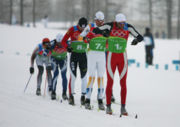
This event took place on 19 February. In the relay, each NOC selected four skiers in a particular order to compete for their team, and the skiers completed the 10 km course in that order. All the athletes who completed the first leg will start at the same time; however, once the first skier completed the 10 km course, he immediately changed over with the next skier, who then completed the next leg of the relay.
The first two skiers skied in classical style, the last two in free style, and the team whose last skier completed the 10 km course first was the winning team. The last relay in the World Cup was held at Beitostølen, Norway on 20 November 2005, and Germany's team of Andreas Schlütter, Axel Teichmann, Jens Filbrich and Tobias Angerer won the competition. Defending World Champions are Norway, with Odd-Bjørn Hjelmeset, Frode Estil, Lars Berger and Tore Ruud Hofstad, and Norway are also Olympic champion, with Anders Aukland, Estil, Kristen Skjeldal and Thomas Alsgaard winning gold at the 2002 Olympics. At Nagano in 1998, the Norwegians beat the Italians by under one tenth of a second, and in 1994 at Lillehammer the Italians beat the Norwegians by less than one tenth of a second, in fact in the last three Olympics the winning team beat the silver medalists by a cumulative time of just under one tenth of a second, so this match-up is considered extremely prestigious in both nations. One further relay event was held before the Olympics, at Val di Fiemme on 15 January 2006, which was won by an Italian team consisting of Giorgio di Centa, Valerio Checchi, Pietro Piller Cottrer and Cristian Zorzi. Four teams finished within 2.6 seconds of the Italian winners.
Hosts Italy won this relay, their fifth straight medal in relays in the Winter Olympics. They were over 15 seconds ahead of any competitors. Sweden took bronze, their first medal since 1988, and Norway failed to win a medal for the first time since 1988.
| Medal | Team | Time |
|---|---|---|
| Gold | Italy (ITA) (Fulvio Valbusa, Giorgio di Centa,
Pietro Piller
Cottrer, Cristian Zorzi) |
1:43:45.7 |
| Silver | Germany (GER) (Andreas
Schlütter, Jens Filbrich, René
Sommerfeldt, Tobias Angerer) |
1:44:01.4 |
| Bronze | Sweden (SWE) (Mats Larsson, Johan Olsson, Anders
Södergren, Mathias
Fredriksson) |
1:44:01.7 |
1.35 km individual sprint
This event took place on 22 February, beginning at 10:30 local time. The competitors began with the qualification event, where each skier was let into the 1.35 km course at 15 second intervals, and they skied the course in free style. The 16 skiers with the lowest times qualified for the elimination heats. The 16 skiers are allotted into four quarter-finals based on their positions in the qualifying event, and the top two in each quarter-final, which is held as a mass start over the 1.35 km course, qualifies for the semi-final rounds. In the two semi-finals, with four skiers in each, there are two spots available for the A final. The eliminated skiers in the semi-finals will ski in the consolation round (B final) for the 5th to 8th places. Vasili Rotchev is defending World Champion at this event, but he won in the classical style. The last free style sprint at the World Championships was won by Thobias Fredriksson in 2003, while Tor Arne Hetland is defending Olympic champion. Swede Björn Lind won the two most recent World Cup events, and also won the Olympic race, beating Frenchman Roddy Darragon to the line. Darragon won France's first cross-country skiing medal in the history of the Olympics, while Sweden took the bronze through Thobias Fredriksson.
| Medal | Athlete | Time |
|---|---|---|
| Gold | Björn
Lind (SWE) |
2:26.5 |
| Silver | Roddy
Darragon (FRA) |
2:27.1 |
| Bronze | Thobias
Fredriksson (SWE) |
2:27.8 |
50 km freestyle mass start
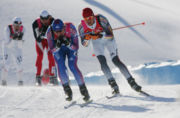
This was the final event of the Olympic games for the cross-country skiers, taking place on 26 February, the day of the closing ceremony. The only other event to take place on this day was the Ice hockey final. The selected skiers started in a pack (mass start) at 10:00 local time, and skied the 50 km course in free style. The first skier to complete the course is the winner. The 50 km has only been skied once as a mass start event at the World Championships, in 2005, which Frode Estil of Norway won. However, that was in the classical style. The last 50 km in free style at a World Championship was in 2003, and Martin Koukal of the Czech Republic won that event. Mikhail Ivanov is defending Olympic champion on 50 km, but technique with individual start. 50 kilometre mass starts have never been held in the World Cup, but the last 50 kilometre free style event (with individual start) in the World Cup was held on 28 February 2004 in Oslo, Norway and was won by René Sommerfeldt.
With a pack of 10–15 skiers coming together towards the finish, Giorgio Di Centa won Italy's second gold medal in cross-country skiing. This was the closest Olympic 50 km ever (0.8 seconds), eclipsing the 4.9 seconds that separated Thomas Wassberg from Gunde Svan (both from Sweden) at the 1984 Winter Olympics in Sarajevo.
| Medal | Athlete | Time |
|---|---|---|
| Gold | Giorgio Di
Centa (ITA) |
2:06:11.8 |
| Silver | Yevgeny
Dementyev (RUS) |
2:06:12.6 |
| Bronze | Mikhail
Botvinov (AUT) |
2:06:12.7 |
Women's events
7.5 km + 7.5 km double pursuit
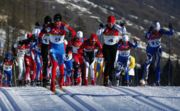
This event was held on February 12, the first cross-country event at the 2006 Olympics. For details on the competition format, see the men's 30 km pursuit, except that the women skied 7.5 km in the classical style and 7.5 km in the free style. Julija Tchepalova is the reigning World Champion in the event, while the Canadian Beckie Scott won the 10 km pursuit at the 2002 Olympics. However, neither were in the medals here; Kristina Smigun and Katerina Neumannová were neck-and-neck coming in to the stadium, but Smigun was the quickest through the last straight and won by 1.9 seconds. Russia's Yevgeniya Medvedeva-Arbuzova took bronze.
| Medal | Athlete | Time |
|---|---|---|
| Gold | Kristina
Smigun (EST) |
42.48.7 |
| Silver | Katerina
Neumannová (CZE) |
42:50.6 |
| Bronze | Yevgeniya
Medvedeva-Arbuzova (RUS) |
43:03.2 |
Team sprint, classical style
This event will be held on 14 February, the same day as the men's event, and just as in the sprint events the women's semi-finals and final immediately precede the men's semi-final and final. The event is scheduled to start at 10:00 local time. This event has been held once in the World Championship, but then as a free technique event, which Hilde Gjermundshaug Pedersen and Marit Bjørgen won for Norway. This event has never before been at the Olympics. The last classical style team sprint in the World Cup was held in Canmore on 18 December 2005 and won by Germany, with Manuela Henkel and Viola Bauer. No further World Cup team sprints are planned before the Olympics.
| Medal | Athlete | Time |
|---|---|---|
| Gold | Sweden (SWE) (Lina Andersson, Anna Dahlberg) |
16:36.9 |
| Silver | > Canada (CAN) (Sara Renner, Beckie Scott) |
16:37.5 |
| Bronze | Finland (FIN) (Aino Kaisa
Saarinen, Virpi Kuitunen) |
16:39.2 |
10 km classical interval start
This event was held on 16 February, and the rules are similar to those employed by the men's 15 km interval start. Defending World Champion at the 10 km event is Katerina Neumannová, however, that was in the free style event, and a classical style 10 km in the World Championship has not been held since 1989. In the World Cup, however, there have been two events this season, both won by Norwegians: Marit Bjørgen won at Kuusamo, Finland in November, and Hilde Gjermundshaug Pedersen at Otepää, Estonia in January. Bente Skari won the Olympic gold in 2002, but will not defend her status, having retired after the 2003 World Championship. One week before the Olympics, the Swiss town of Davos will host the last 10 km before the World Cup.
Šmigun won her second gold of the Olympics, winning 21 seconds ahead of Marit Bjørgen, and two more Norwegians followed.
| Medal | Athlete | Time |
|---|---|---|
| Gold | Kristina
Smigun (EST) |
27.51.4 |
| Silver | > Marit
Bjørgen (NOR) |
28:12.7 |
| Bronze | Hilde
Pedersen (NOR) |
28:14.0 |
4 × 5 km relay
This event is scheduled for 18 February, starting at 9:45 local time. Except for the shorter distance, the relay is organised in exactly the same way as the men's relay. Vibeke Skofterud, Hilde Gjermundshaug Pedersen, Kristin Størmer Steira and Marit Bjørgen of Norway are the defending World Champions, but finished third at the World Cup event in Val di Fiemme, where a team representing Finland won. Germany are defending Olympic champions, however, with Claudia Künzel, Manuela Henkel, Viola Bauer and Evi Sachenbacher.
| Medal | Team | Time |
|---|---|---|
| Gold | Russia (RUS) (Natalia
Baranova-Masolkina, Larisa Kurkina, Yuliya Chepalova,
Yevgeniya
Medvedeva-Arbuzova) |
54:47.7 |
| Silver | Germany (GER) (Stefanie
Böhler, Viola Bauer, Evi
Sachenbacher-Stehle, Claudia
Künzel) |
54:57.7 |
| Bronze | Italy (ITA) (Arianna Follis, Gabriella
Paruzzi, Antonella
Confortola, Sabina Valbusa) |
54:58.7 |
1.1 km individual sprint
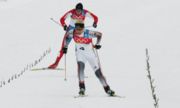
This event was held on 22 February, the same day as the men's events, and the elimination stages of the women's sprint will be held just before the corresponding elimination stage of the men's sprint. The competition will be staged in a similar way to the men's event, however. Emilie Öhrstig is defending World Champion, but she won in the classical style, and the last free style sprint in the World Championships (in 2003) was won by Marit Bjørgen. Julija Tchepalova is defending Olympic champion. The most recent free style sprint event in the World Cup, however, was won by the Russian Alena Sidko at 30 December 2005.
On February 22, 2006, Canada's Chandra Crawford captured the gold medal in the 1.1-kilometre sprint in her Olympic debut. Teammate Beckie Scott finished fourth.
| Medal | Athlete | Time |
|---|---|---|
| Gold | Chandra
Crawford (CAN) |
2:12.3 |
| Silver | Claudia
Künzel (GER) |
2:13.0 |
| Bronze | Alena Sidko (RUS) |
2:13.2 |
30 km freestyle mass start
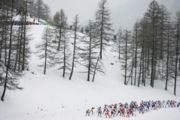
This event was held on 24 February, the last of the women's cross country events at the 2006 Olympics. The rules were similar to the men's 50 km free style, and once again there has been no 30 km free style mass starts in the World Championships nor in World Cups before.
Marit Bjørgen was defending World Champion, while the last 30 km free style (with individual start) in the World Cup was won by Yuliya Chepalova on 28 February 2004. The event has never been held as a mass start at the Olympics, but the last 30 km (a classical individual start event) was won by Gabriella Paruzzi of Italy.
Veteran Katerina Neumannová won her second medal at the Torino Olympics. Her daughter, Luci, greeted the exhausted Neumannová after she won.
Newcommer Justyna Kowalczyk won the first ever Olympic medal in cross-country skiing for Poland, for either men or women.
Two weeks later, Chepalova defeated Neumannová by 17.2 seconds at the Holmenkollen event in Oslo. Kowalczyk finished 13th.
| Medal | Athlete | Time |
|---|---|---|
| Gold | Katerina
Neumannová (CZE) |
1:22:25.4 |
| Silver | Yuliya
Chepalova (RUS) |
1:22:26.8 |
| Bronze | Justyna
Kowalczyk (POL) |
1:22:27.5 |
Qualification
An NOC may enter 28 qualified athletes over the Nordic skiing events with a maximum of 20 athletes for Cross-country disciplines. A maximum of four athletes may participate in a single individual event, and one team in each relay race.
Participating nations
Fifty-three nations contributed 336 cross-country skiers to compete in the events. Below is a list of the competing nations; in parentheses are the number of national competitors.
|
|
|
|
 Algeria
  Andorra
  Argentina
  Armenia
  Australia
  Bosnia
and Herzegovina<
Bosnia
and Herzegovina<
 Belarus
  Brazil
  Bulgaria
  China
China  Costa
Rica
Costa
Rica  Croatia
  Spain
Spain  Ethiopia
  Hungary
  India
India  Iran
Iran  Ireland
  Japan
Japan  Kazakhstan
  Kenya
Kenya  South
Korea
South
Korea  Latvia
  Liechtenstein
  Lithuania
  Moldova
  Monaco
  FYR
Macedonia
FYR
Macedonia  Nepal
Nepal  Portugal
  Romania
  South
Africa&nbs
South
Africa&nbs
 Serbia
and Montenegro
Serbia
and Montenegro  Slovenia
  Switzerland
  Slovakia
  Thailand
  Turkey
  Ukraine
  United
States
United
States