Cincinnati Bengals Team History
Professional football returned to Cincinnati Ohio in 1967 when Paul Brown headed an ownership group which landed an expansion franchise in the modern-era American Football League.
Brown, a Pro Football Hall of Famer who founded and coached the Cleveland Browns from 1946-62, picked the name Bengals for the new team "to give it a link with past professional football in Cincinnati." Hundreds of names were suggested by fans in an effort to name the new Cincinnati team, the most popular being Buckeyes. It was rejected to avoid confusion with the Ohio State Buckeyes. The Bengals began play in the AFL in 1968. The AFL merged with the NFL in 1970, and the Bengals have been members ever since.
The Cincinnati Bengals are a member of the AFC North division.
Cincinnati Bengals Chronological History
1939
The Bengals joined a new AFL, finishing in second place with a 6-2 record. But again, the league folded after the season.
1940
Another new AFL emerged, and again the Bengals joined. They recorded 1-7-0 and 1-5-2 marks in 1940 and 1941, respectively. That AFL suffered the fate of the two AFLs before it, folding after the 1941 season as the United States entered World World II. Only this time, the Bengals folded along with it.
1967
Pro football returned to Cincinnati after 26 years hiatus when Paul Brown headed an ownership group which landed an expansion franchise in the modern-era American Football League. Brown, a Pro Football Hall of Famer who founded and coached the Cleveland Browns from 1946-62, picked the name Bengals for the new team "to give it a link with past professional football in Cincinnati."
1968
The current incarnation of the Bengals joined a different AFL.
1970
The Bengals join the NFL when the AFL and NFL merge. In their very first NFL season, the team won the AFC Central Division.
1973
The Bengals qualify for postseason.
1975
They qualify for postseason play yet again.
1981
The Bengals win the division crown.
1982
Super Bowl XVI Lost to San Francisco 49ers, 26-21
1985
Boomer Esiason replaces Ken Anderson as QB and goes on to become an NFL star player.
1989
Super Bowl XXIII Lost to San Francisco 49ers, 20-16
1988
The team finished with a 12-4 win-loss record. Esiason wins the first of two NFC passing titles and also wins player of the year honors. The Bengals qualify for the Super Bowl but fall to the San Francisco 49er's when they score a last minute touchdown.
1990
Cincinnati won its fifth division title. Esiason notched his sixth consecutive 3,000 yard season, a club record. The Bengals won a total of just 11 games from 1992 to 1994, and the team continued to struggle for much of the rest of the 1990s.
1992
David Shula (son of legendary Miami Dolphins' coach Don Shula) was promoted from WR position coach to head coach in 1992 as the youngest NFL head coach.
1996
Former Bengals' tight end, and long-time offensive coordinator, Bruce Coslet took over the coaching duties midway through the 1996 season and coached the Bengals through the first three games of the 2000 season, losing his last game to the Baltimore Ravens 37-0. Coslet won 21 and lost 39 as Bengals' head coach.
1997
the Bengals designed a logo consisting of a leaping tiger, and it was added to the uniform sleeves. Another alternate logo consisted of a Bengal's head facing to the left. However, the orange helmet with black tiger stripes continued to be the team's primary trademark.
2003
Jon Kitna had a comeback year (voted NFL Comeback Player of the Year)
2004
Carson Palmer was promoted to starting quarterback the following season and Kitna, apparently happily, took the position of backup quarterback and embraced the role of mentor for the young quarterback.
2009
Chris Henry fall sout of a pickup truck during a domestic dispute and died from his injuries
2010
The biggest 2010 acquisition for the Bengals was veteran WR Terrell Owens, signed in July. This move was controversial, as Owens was quite old at 36 and had caused considerable problems while playing in San Francisco, Philadelphia, and Dallas. Perhaps more controversial was the signing of CB Adam "Pacman" Jones, who had been involved in a shooting at a Las Vegas nightclub in 2007.
2011
Carson Palmer demands to be traded to another team. Mike Brown flatly refused to either release or trade him, and Palmer instead announced his plans to retire from the NFL.
2013
Cincinnati Bengals look to have their most successful season in history. They clinch the AFC North title with an 11-5 record only to fall to the San Diego Chargers 27-10 after having a 10 - 7 halftime lead.
Cincinnati Bengals Franchise Information
- Franchise Granted: 1968
- First Season: 1968
- Franchise History:
- 1968 - 1969 Cincinnati Bengals (AFL)
- 1970 - Present (NFL)
Paul Brown selected the name because there had once been a pro football team in Cincinnati named the Bengals and adopting that name "would provide a link with past professional football in Cincinnati."
Cincinnati Bengals - Stadium
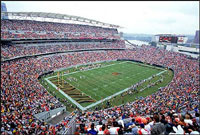
One Paul Brown Stadium
Cincinnati, Ohio 45202
Surface Grass
Seating 65,600
Opened Sept. 10, 2000
Phone (513) 621-3550
Fax (513) 621-3570
Tenants:
Cincinnati Bengals
Previous Stadiums
Nippert Stadium (26,500) 1968-69
Cinergy Field (60,389) 1970-99
** Renamed to Riverfront Stadium 1970-96
Cincinnati Bengals

League Championships
None
Conference Championships
1981 (AFC), 1988 (AFC)
Division Championships
1981 (AFC North), 1988 (AFC North)
Wild Card Wins
1990 (AFC North)
Years in Playoffs
1970, 1973, 1975, 1981, 1982, 1988, 1990, 2005, 2009, 2011, 2012, 2013
Coaches
Retired Numbers
#54 Bob Johnson
Hall of Fame Members
Paul Brown
1968, 1969, 1970, 1971, 1972, 1973, 1974, 1975
Forrest Gregg
1980, 1981, 1982, 1983
Charlie Joiner
1972, 1973, 1974, 1975
Anthony Munoz
1980, 1981, 1982, 1983, 1984, 1985, 1986, 1987, 1988, 1989, 1990, 1991, 1992